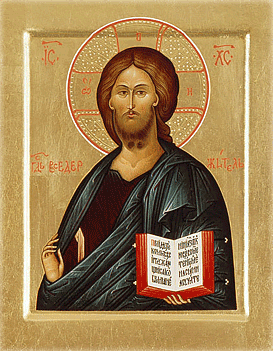
The central worship service of the Orthodox Church, celebrating the Eucharist (Holy Communion). Usually celebrated on Sundays and feast days, the Divine Liturgy consists of the Liturgy of the Word (scripture readings) and Liturgy of the Faithful (Eucharistic prayer and communion). The most common forms are the Liturgies of St. John Chrysostom and St. Basil the Great.
All-Night Vigil
A lengthy service combining Vespers and Matins, traditionally celebrated on the eve of Sundays and major feasts. The All-Night Vigil includes the singing of "Lord, I Call," the Magnificat, the Great Doxology, and numerous psalms and hymns. This service prepares the faithful spiritually for the upcoming feast.
Palm Sunday
The celebration of Christ's triumphal entry into Jerusalem, when crowds welcomed Him with palm branches. This feast begins Holy Week and is marked by the blessing and procession of palm branches (or pussy willows in northern climates). The service combines joy for Christ's kingship with anticipation of His upcoming Passion.
Matins (Orthros)
The morning prayer service of the Orthodox Church, traditionally celebrated at dawn. Also called Orthros in Greek tradition, this service includes the reading of the Gospel, the Great Doxology, and numerous psalms and hymns. Matins prepares the faithful for the day and is often celebrated immediately before the Divine Liturgy on Sundays and feast days.
St. Tikhon of Moscow
The Patriarch of Moscow who led the Russian Orthodox Church through the Communist persecution. Celebrated on April 7th, Tikhon was elected Patriarch in 1917 and courageously opposed Soviet attempts to control the Church. He defended Orthodox faith and clergy during the most difficult period of Russian Church history. He represents faithful leadership under persecution.
Presanctified Liturgy
A special Lenten service combining Vespers with communion using bread consecrated at a previous Divine Liturgy. Celebrated on Wednesday and Friday evenings during Great Lent, this service allows the faithful to receive communion during the fasting period without celebrating the full Divine Liturgy. It maintains the penitential character of Lent while providing spiritual nourishment.
Holy Unction
The sacrament of healing for physical and spiritual ailments, administered by anointing with blessed oil. Also called the sacrament of anointing or Euchelaion, this service is traditionally celebrated by seven priests (though one may serve) who read seven Gospel passages and anoint the person seven times on the forehead, nostrils, cheeks, lips, chest, and hands. Holy Unction is offered not only to the dying but to all who are sick in body or soul, and many parishes celebrate it communally during Great Lent. The service emphasizes God's healing power and mercy.
Vespers
The evening prayer service of the Orthodox Church, traditionally celebrated at sunset. Vespers includes psalms, hymns, scripture readings, and incense. On Saturday evenings, Great Vespers is often combined with the Sunday Divine Liturgy. The service marks the end of the liturgical day and prepares the faithful for rest and reflection.
Crucifixion of Christ
The commemoration of Christ's death on the Cross on Holy Friday. The Church observes this solemn day with the Royal Hours, Vespers with the procession of the Epitaphios (burial shroud), and Matins of Holy Saturday. This is a strict fast day. The services emphasize Christ's voluntary suffering for our salvation and His victory over death through death.
The Hours
Brief prayer services traditionally celebrated at specific times of day: First Hour (6 AM), Third Hour (9 AM), Sixth Hour (noon), and Ninth Hour (3 PM). Each Hour includes psalms, troparia, and prayers appropriate to that time of day. These services sanctify the day and connect us to Christ's Passion, as they commemorate specific moments in His crucifixion and death.
Holy Baptism
The sacrament of initiation into the Orthodox Church, through which a person is united with Christ in His death and resurrection. The baptismal candidate is immersed three times in water in the name of the Father, Son, and Holy Spirit, dying to sin and rising to new life in Christ. Baptism cleanses from original sin, grants adoption as God's child, and makes the person a member of the Body of Christ. In Orthodox practice, baptism is immediately followed by chrismation and first communion.
Holy Chrismation
The sacrament of sealing with the Holy Spirit, administered immediately after baptism in the Orthodox Church. The priest anoints the newly baptized with holy chrism (myrrh) on the forehead, eyes, nostrils, ears, lips, chest, hands, and feet, saying "The seal of the gift of the Holy Spirit." This sacrament completes baptism and grants the fullness of the Holy Spirit, enabling the person to participate fully in the life of the Church. It corresponds to the Western sacrament of Confirmation but is given to infants.
Pascha
The "Feast of Feasts" celebrating Christ's Resurrection from the dead. The most important celebration in the Orthodox Church, Pascha determines the date of all moveable feasts. The service begins with the joyful midnight proclamation "Christ is Risen!" and continues with the Divine Liturgy of St. John Chrysostom.
Great Martyr George
The soldier-saint martyred under Diocletian, venerated as the 'Trophy-Bearer' for his victory over evil. Celebrated on April 23rd, George is patron of soldiers, England, and Georgia. The legend of his slaying a dragon symbolizes triumph over evil. His courage in maintaining faith despite torture makes him a model of Christian fortitude.
Apostle Mark
The evangelist who wrote the shortest Gospel, emphasizing Christ's divine power through miracles. Celebrated on April 25th, Mark was a companion of both Peter and Paul. He founded the Church in Alexandria and is patron of Venice. His Gospel, likely the first written, served as a source for Matthew and Luke.